Cross-Border E-Commerce
US & Canada Sales Tax Playbook
A practical guide to US Wayfair economic nexus and the Canada GST/HST/PST framework — the compliance roadmap for Amazon FBA, Shopify, and cross-border sellers.
Canada Sales Tax
Why Cross-Border Sellers Must Understand Canadian Sales Tax
Many ecommerce sellers assume Amazon handles everything. In reality, Canada's sales tax system is a dual federal + provincial architecture with widely varying rules by province. Sellers may trigger registration obligations due to inventory storage, sales thresholds, or sales through their own website — even if they only sell through marketplace platforms.
- 01 Five Tax Types — Federal GST 5% · HST 13–15% · Provincial PST/RST · Quebec QST · Manitoba RST
- 02 MPF Collection — Since 2021, Amazon.ca auto-collects in all provinces, but seller registration obligations remain
- 03 Thresholds — GST/HST small supplier exemption is CAD $30,000; non-resident sellers face separate registration rules
Four Key Sales Tax Types in Canada
Canada Provincial Sales Tax Rate Table (2026)
| Province / Territory | Tax Type | GST | Provincial | Total | Amazon Collects |
|---|---|---|---|---|---|
| Ontario ON | HST | — | — | 13% | ✓ Yes |
| Quebec QC | GST+QST | 5% | 9.975% | 14.975% | ✓ Yes |
| British Columbia BC | GST+PST | 5% | 7% | 12% | ✓ Yes |
| Alberta AB | GST | 5% | — | 5% | ✓ Yes |
| Manitoba MB | GST+RST | 5% | 7% | 12% | ✓ Yes |
| Saskatchewan SK | GST+PST | 5% | 6% | 11% | ✓ Yes |
| New Brunswick NB | HST | — | — | 15% | ✓ Yes |
| Nova Scotia NS | HST | — | — | 14% | ✓ Yes |
| Prince Edward Island PE | HST | — | — | 15% | ✓ Yes |
| Newfoundland & Labrador NL | HST | — | — | 15% | ✓ Yes |
| Yukon / NWT / Nunavut | GST | 5% | — | 5% | ✓ Yes |
⚠️ Amazon collects tax as an MPF, but sellers must still confirm their registration status and file periodic returns.
Non-Resident Registration Thresholds
Registration Decision Flow
Canada 5-Step Compliance Roadmap
US Sales Tax
Post-Wayfair · Economic Nexus in 45 States
Following the 2018 South Dakota v. Wayfair Supreme Court decision, all 45 sales-tax states adopted economic nexus rules — meaning remote sellers must collect and remit sales tax once sales thresholds are crossed, even without physical presence. Amazon FBA inventory creates immediate physical nexus; Shopify independent stores are entirely the seller's responsibility.
Key State Thresholds (2026)
| State | Sales Threshold | State Rate | Amazon | Notes |
|---|---|---|---|---|
| California CA | $500,000 | 7.25% | ✓ | Local tax up to 10% |
| Texas TX | $500,000 | 6.25% | ✓ | Separate Permit required |
| New York NY | $500K & 100 transactions | 4.0% | ✓ | State+city can reach 8.875% |
| Florida FL | $100,000 | 6.0% | ✓ | FBA warehouse = physical nexus |
| Washington WA | $100,000 | 6.5% | ✓ | Also has B&O business tax |
| Illinois IL | $100,000 | 6.25% | ✓ | Combined rate can reach 11% |
| Pennsylvania PA | $100,000 | 6.0% | ✓ | Common FBA warehouse state |
| Alabama AL | $250,000 | 4.0% | ✓ | Higher threshold state |
| Most Other States | $100,000 | 4–7% | ✓ | DE/MT/NH/OR: no sales tax |
Sources: Avalara / Tax Foundation (updated April 2026) · Verify with each state's official website
Amazon vs. Shopify — Sales Tax Mechanics Compared
Amazon · Platform Collection
- Amazon auto-collects and remits sales tax in all sales-tax states as an MPF
- FBA distributes inventory to multiple state warehouses — creating physical nexus even at low sales volumes
- Platform collection ≠ state income tax filing; you must still assess state income/franchise tax obligations
- Sales of $5,000+ generate a 1099-K that state tax agencies cross-reference
Shopify · Seller's Responsibility
- Shopify independent stores are NOT Marketplace Facilitators — full tax obligation rests with the seller
- Since 2025, orders via the Shop App are collected by Shopify; orders via your own domain remain your responsibility
- Enable tax rates state-by-state in Settings → Taxes and enter each Permit number
- File monthly/quarterly even with zero sales — zero-dollar filings are required in most states
All-State Economic Nexus Thresholds (2026)
All 50 states' economic nexus thresholds · Source: Avalara / Tax Foundation (2026)
| State | Abbr. | Effective Date | Sales Threshold | Transaction Count | Marketplace | Reporting |
|---|---|---|---|---|---|---|
| Alabama | AL | 10/1/2018 | 250000 | na | Excluded | |
| Alaska | AK | 100000 | Included | |||
| Arizona | AZ | 2019-10-01 | 100000 | Excluded | ||
| Arkansas | AR | 2019-07-01 | 100000 | 200 | Excluded | |
| California | CA | 2019-04-01 | 500000 | Included | ||
| Colorado | CO | 2019-04-14 | 100000 | Excluded | ||
| Connecticut | CT | 12/1/2018 | 100000 | 200 | Included | |
| D.C. | DC | 2019-01-01 | 100000 | 200 | Included | |
| Florida | FL | 2021-07-01 | 100000 | Excluded | ||
| Georgia | GA | 2020-01-01 | 100000 | 200 | Excluded | |
| Hawaii | HI | 7/1/2018 | 100000 | 200 | Included | |
| Idaho | ID | 2019-06-01 | 100000 | Included | ||
| Illinois | IL | 10/1/2018 | 100000 | 200 | Excluded | |
| Indiana | IN | 10/1/2018 | 100000 | Excluded | ||
| Iowa | IA | 1/1/2019 | 100000 | Included | ||
| Kansas | KS | 2021-07-01 | 100000 | Included | ||
| Kentucky | KY | 10/1/2018 | 100000 | 200 | Included | |
| Louisiana | LA | 2020-07-01 | 100000 | Excluded | ||
| Maine | ME | 7/1/2018 | 100000 | Excluded | ||
| Maryland | MD | 10/1/2018 | 100000 | 200 | Included | |
| Massachusetts | MA | 2019-10-01 | 100000 | Excluded | ||
| Michigan | MI | 10/1/2018 | 100000 | 200 | Included | |
| Minnesota | MN | 2019-10-01 | 100000 | 200 | Included | |
| Mississippi | MS | 9/1/2018 | 250000 | Excluded | ||
| Missouri | MO | 2023-01-01 | 100000 | Included | ||
| Nebraska | NE | 2019-04-01 | 100000 | 200 | Included | |
| Nevada | NV | 2018-11-01 | 100000 | 200 | Included | |
| New Jersey | NJ | 2018-11-01 | 100000 | 200 | Included | |
| New Mexico | NM | 2019-07-01 | 100000 | Excluded | ||
| New York | NY | 2018-06-24 | 500000 | 100 | Included | |
| North Carolina | NC | 11/1/2018 | 100000 | Included | ||
| North Dakota | ND | 10/1/2018 | 100000 | Excluded | ||
| Ohio | OH | 2019-08-01 | 100000 | 200 | Included | |
| Oklahoma | OK | 2019-11-01 | 100000 | Excluded | ||
| Pennsylvania | PA | 2019-07-01 | 100000 | Included | 10000 | |
| Rhode Island | RI | 8/17/2017 | 100000 | 200 | Included | |
| South Carolina | SC | 11/01/2018 | 100000 | Included | ||
| South Dakota | SD | 11/1/2018 | 100000 | Included | ||
| Tennessee | TN | 2019-10-01 | 100000 | Excluded | ||
| Texas | TX | 2019-10-01 | 500000 | Included | ||
| Utah | UT | 1/1/2019 | 100000 | Excluded | ||
| Vermont | VT | 7/1/2018 | 100000 | 200 | Included | |
| Virginia | VA | 2019-07-01 | 100000 | 200 | Excluded | |
| Washington | WA | 2019-03-14 | 100000 | Included | 10000 | |
| West Virginia | WV | 2019-01-01 | 100000 | 200 | Included | |
| Wisconsin | WI | 10/1/2018 | 100000 | Included | ||
| Wyoming | WY | 2019-02-01 | 100000 | Excluded | ||
| Note 1: Reporting requirement: Generally speaking, if a seller does not collect sales/use taxes, there is a reporting requirment for the seller to report name of customer, address, order date and amount etc. | ||||||
| Other than economic nexus, sellers or other businesses with inventories, sales person, servers to receive orders or other factors which may create sales/use tax nexus in a state should consult a professional accountant or tax adviser to ensure sales/use tax compliance. For most states, keeping inventories in a warehouse in a state creates sales/tax nexus. Therefore, FBA sellers likely have sales/use tax nexus in any FBA state where they have inventories. |
🗺️ Interactive US Sales Tax Maps
US Economic Nexus Threshold Map
Displays threshold type by state — sales-only / sales or transactions / no state sales tax. Hover to see details.
Do Exempt Sales Count Toward Nexus? (By State)
Shows whether each state counts exempt sales toward the economic nexus threshold — a key compliance distinction.
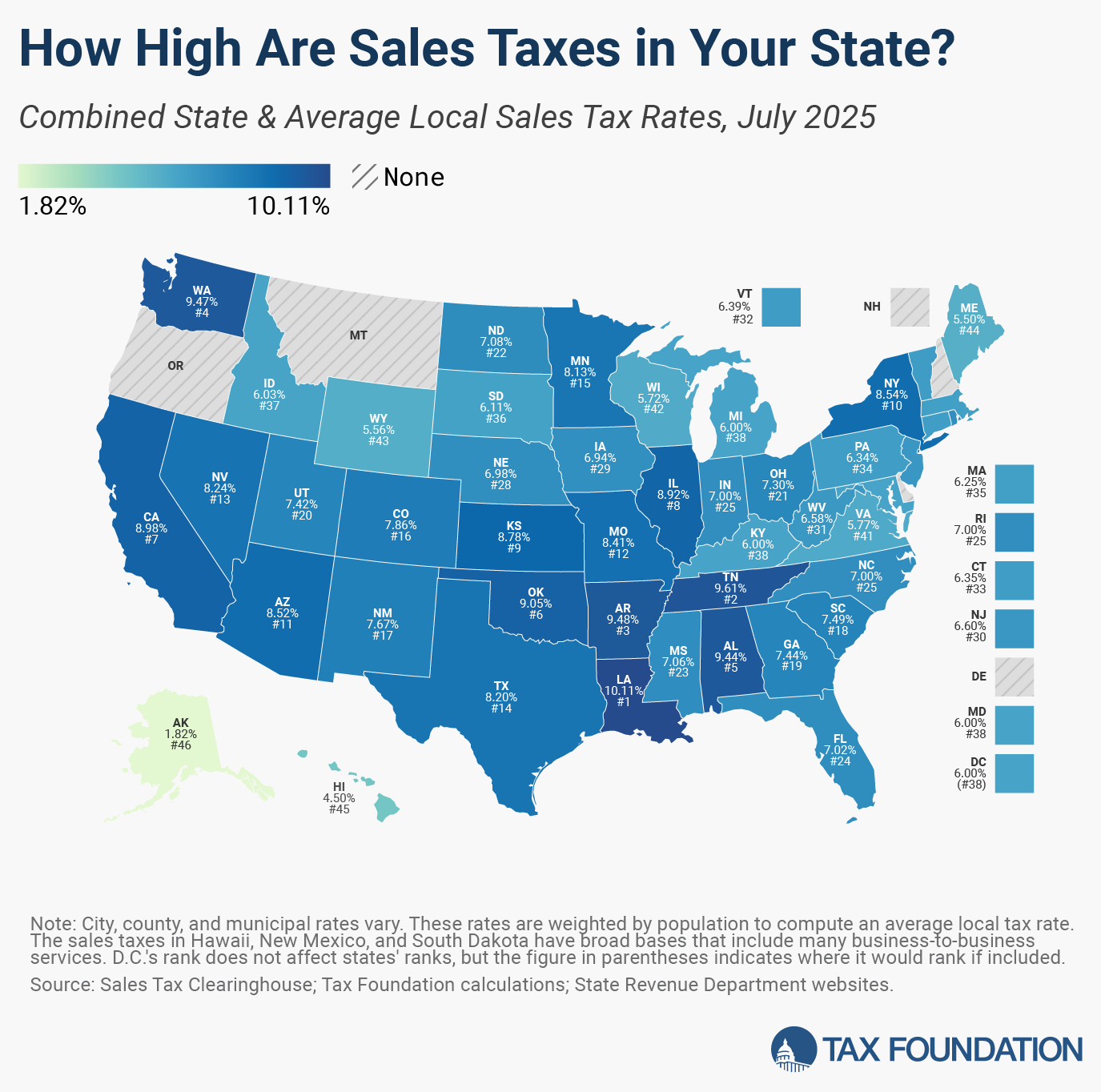
Combined State & Average Local Sales Tax Rate Map
Visual overview of each state's total tax burden — combined state-level and average local sales tax rates.
US 5-Step Compliance Roadmap
Frequently Asked Questions
🇺🇸 US Sales Tax
🇨🇦 Canada Sales Tax
Disclaimer: This content is updated as of 2026 and is for general informational purposes only. It does not constitute professional tax, legal, or accounting advice. Please consult a licensed professional for guidance specific to your situation.
Still have questions after reading?
Book a free 30-minute assessment with a US & Canadian CPA — tailored to your specific situation.
Book Free Assessment